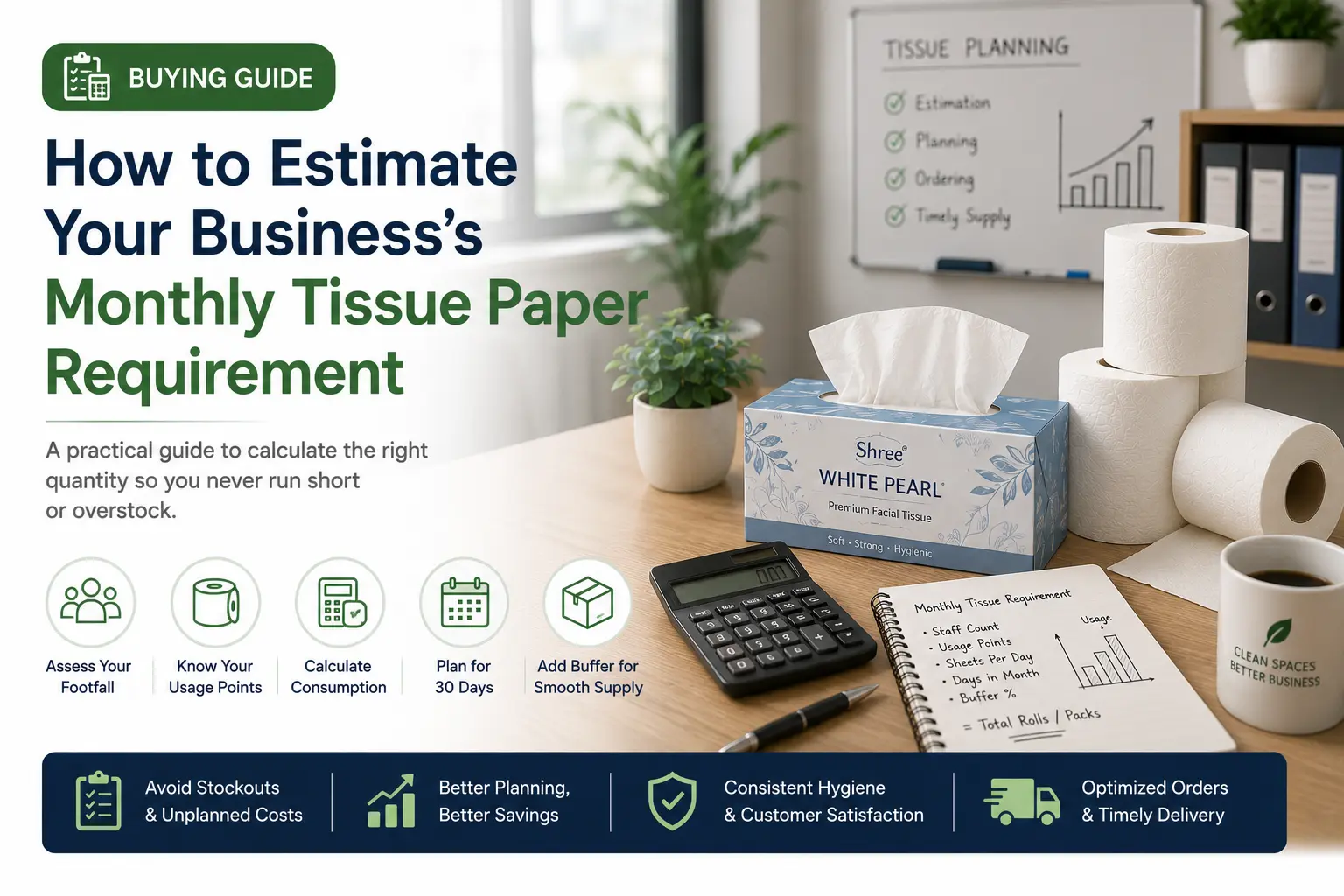
Ordering tissue paper without a clear estimate usually leads to one of two problems: running short and scrambling for emergency top-ups, or over-ordering and tying up cash and storage space in stock you won't use for months. A simple, repeatable estimation method fixes both. Here's a practical approach any business can apply.
Start with a per-person, per-day baseline
The simplest starting point is usage per employee or guest per day — how many sheets or grams of tissue a typical person consumes across restrooms, pantries and common areas in a normal working day. You don't need scientific precision here; a rough estimate based on your own observation over a couple of weeks is enough to build a working baseline you can refine later.
Multiply by headcount or footfall, not capacity
Use your actual average daily headcount or footfall, not your building's maximum capacity. An office with 100 desks but a typical daily attendance of 70 should order against 70, with a buffer for occasional full-attendance days — not against a number no ordinary day reaches. This single adjustment prevents most cases of chronic overstocking.
Adjust for seasonality and footfall spikes
Retail, hospitality and food service businesses often see predictable seasonal swings — festival periods, tourist seasons, event calendars. Build these into your monthly estimate rather than treating every month as identical. A hotel with a known wedding season, for instance, should plan a higher order for those months well ahead of time rather than reacting once occupancy climbs.
Build in safety stock
Even a good estimate can be thrown off by a delayed delivery, an unusually busy week, or a supplier issue. A safety stock buffer — commonly one to two weeks of average usage — absorbs these surprises without triggering a shortage. Treat this buffer as untouchable reserve stock, not part of your regular rotation, so it's genuinely there when you need it.
Practical Tip
Track actual consumption for two to three months after you start ordering against an estimate, then compare it to what you planned. Most businesses find their real usage settles into a fairly predictable pattern once seasonal noise is accounted for, which lets you fine-tune future orders with real data instead of guesswork.
Review and refine periodically
Headcount changes, business hours shift, and product specifications sometimes change too — all of which affect consumption. Revisit your estimate every quarter or after any significant change in operations, rather than setting an order quantity once and leaving it untouched for years.
At Shree Enterprise, our White Pearl tissue paper and White Leaf toilet paper rolls are available in flexible bulk quantities, so your order can scale up or down as your estimate evolves. If you'd like help sizing your monthly requirement, get in touch for a quote and we'll work through the numbers with you.