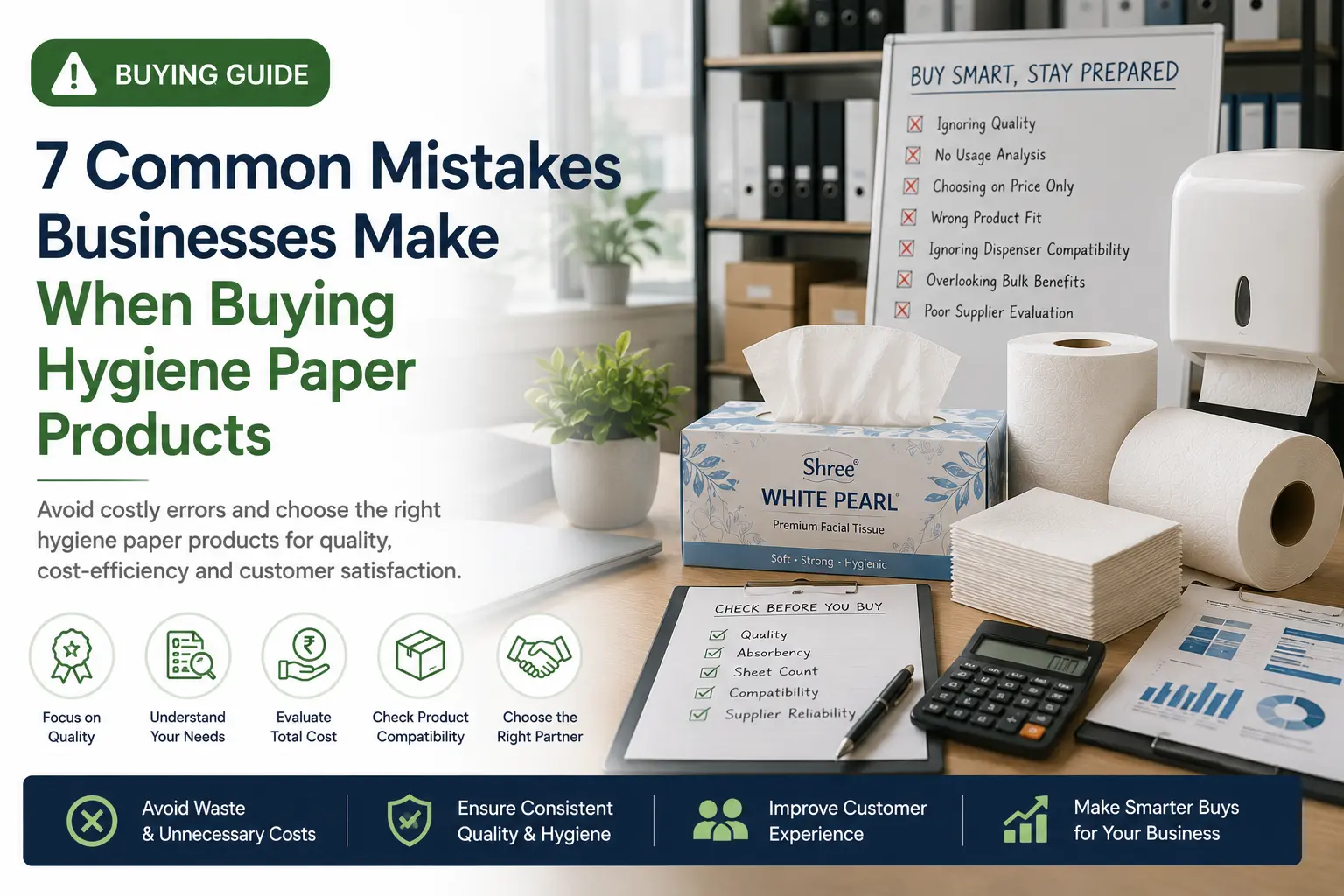
Hygiene paper is a recurring, high-volume purchase, which means small mistakes in how you buy it compound quickly across a year. Most of the issues we see businesses run into aren't dramatic — they're small oversights repeated order after order. Here are seven of the most common ones, and how to avoid them.
1. Chasing the lowest price per unit
The cheapest quote per roll or per carton often isn't the cheapest option once you account for sheet count, sheet size and how quickly the product wears down in use. Always calculate cost-per-use rather than comparing headline unit prices — it's a more honest measure of value and frequently changes which supplier actually comes out ahead.
2. Ignoring supply reliability and lead times
A slightly cheaper supplier who delivers late or inconsistently can cost you more in emergency purchases and operational disruption than you saved on price. Ask any prospective supplier about typical lead times and how they handle demand spikes before you commit, not after your first shortage.
3. Not testing samples before bulk ordering
Committing to a large order based on a spec sheet alone is a common way to discover, too late, that the product doesn't perform as expected in your actual space. A sample test — softness, strength, lint, consistency — takes very little time and prevents an expensive mismatch.
4. Mismatching ply or GSM to the wrong space
Using a premium 3-ply product in a high-frequency back-of-house area wastes budget; using a thin 1-ply product in a guest-facing washroom undersells your brand. Match the specification to where the product will actually be used, rather than applying one standard across every space.
5. Underestimating consumption and running short
Ordering against a rough guess rather than a calculated estimate — based on headcount, footfall and a safety buffer — is one of the most common causes of mid-cycle shortages. A simple monthly estimation method, reviewed periodically, largely eliminates this problem.
Practical Tip
Most of these mistakes share a common root cause: treating each order as an isolated transaction instead of part of an ongoing, trackable supply pattern. Keeping simple records of what you ordered, when, and how long it lasted turns guesswork into a repeatable, improvable process.
6. Treating it as a one-time decision, not a relationship
Businesses often select a supplier once and never revisit that decision, even as their needs or the supplier's performance changes. Reliable hygiene paper supply works better as an ongoing relationship — one where the supplier understands your patterns and can flag issues proactively — rather than a purely transactional, price-only interaction.
7. Not asking about packaging and case sizes
A great price can lose its appeal fast if the case size doesn't fit your storage space, forcing awkward splits or overflow storage. Confirm rolls-per-case or sheets-per-case and physical case dimensions before ordering, especially if your storage area is limited.
At Shree Enterprise, we work with businesses to get specifications, quantities and packaging right from the first order — our White Pearl tissue paper and White Leaf toilet paper rolls are available across the ply, GSM and packaging combinations most businesses need. If you'd rather avoid these mistakes altogether, get in touch for a quote and we'll help you plan it properly.